Guide 04
Numerical record
The current completed trajectory, its verification, and its numerical limits.
Oliver · completed outer-refinement run
The AMReX / incflo trajectory starts at exact rest and reaches t = 0.995. Its completion audit finished on September 23, 2026 at 14:15 UTC. All 280 planned native states passed readback, with zero archived-force discrepancy. The full 5,510-step history passed its clock and endpoint checks.
| Run configuration and endpoint | Value |
|---|---|
| Base grid / fixed levels | 128³ / 5, with 27 outer refinement bands |
| Stored / active cells | 12,055,040 / 10,810,304 |
| Finest spacing | 1 / 1024, inside the ±0.0625 core cube |
| Saved states / final step | 280 / 5,510 |
| Maximum timestep / forcing-phase ceiling | 0.00025 / 0.0375 |
| Endpoint peak speed | 7.415301682 model units |
| Endpoint kinetic energy | 0.038288832 model units |
| RMS velocity deviation from target | 0.001613819 |
| Maximum component deviation from target | 0.280880827 |
| Native force readback discrepancy | 0 across all 280 states |
| Peak process memory | 8.97 GiB, below the 11.5 GiB guard |
| Integration wall time | 131.20 hours, before the final archive audit |
The current completion record and movie record bind all 320 displayed states to the accepted lineage: this 280-state Oliver parent followed by the 40-state Mali continuation through t = 0.9975. The flow, force, and mesh views use the same outer-refinement geometry, and the two movies share one saved-time clock.
What the checks establish
The complete from-rest history, output clock, native archive, and implemented discrete-force readback are verified. RMS and maximum component deviations compare the computed velocity against the prescribed target on active native cells. They do not measure error against an independently known continuum solution.
The finite manufactured force depends on grid spacing. The finest core spacing is 1/1024, and core convergence remains unproven. This finite run stops before t = 1 and cannot establish singularity formation or the paper’s infinite all-order cancellation construction.
Matched fixed-cube refinement
This comparison uses Mali’s 32³-base, Oliver’s 64³-base, and Kay’s 128³-base five-level trajectories, each with the same four nested physical cubes. It does not compare the current featured outer-band mesh. All three completed 280 native states from rest through 0.995 and passed their archive audits. Their solver binary, force profile, integration limits, and saved-time schedule match. Each finer field is volume-restricted onto the preceding grid at six exactly matched times. The 32³→64³ and 64³→128³ records include run hashes and checker outputs.
| Saved time | Velocity 32³→64³ | Velocity 64³→128³ | Forcing 32³→64³ | Forcing 64³→128³ |
|---|---|---|---|---|
| 0.699573 | 5.95% | 2.29% | 14.04% | 12.33% |
| 0.851212 | 7.87% | 3.26% | 23.60% | 17.34% |
| 0.949933 | 8.45% | 3.48% | 24.10% | 17.29% |
| 0.979917 | 9.07% | 3.91% | 25.93% | 17.97% |
| 0.990054 | 9.78% | 4.28% | 21.46% | 17.78% |
| 0.995000 | 10.29% | 4.54% | 26.87% | 18.19% |
Each percentage divides the active composite-domain L² difference by the corresponding restricted finer-field L² norm. Both gaps decrease from 32³→64³ to 64³→128³ at every shown time, but the endpoint 64³→128³ active-cell maximum velocity-component difference is still 0.521 model units. Nearly identical peak speeds do not establish field convergence. The manufactured force uses grid-dependent derivatives, so these three resolutions measure sensitivity rather than an observed convergence order for one fixed continuum forcing. Timestep refinement and further matched meshes are needed before identifying a resolved interval.
The working visualization gate is at most 2% velocity and 5% forcing relative L² difference at predefined matched checkpoints, followed by a fixed-force timestep check below one-quarter of the spatial gap. At 0.995 the finest pair exceeds both spatial targets. These practical thresholds do not certify a continuum error or singularity; they determine when a precursor movie can be presented as resolution-qualified.
Exploratory onset interval
Eight earlier scheduled active states from 0.565536 through 0.699573 were checked in the same way; the 32³→64³ and 64³→128³ records retain every matched field comparison. Across these states the finest-pair velocity gap ranges from 2.19% to 2.47%. Its forcing gap rises from 2.59% to 12.33%, last staying below 5% at 0.629071. No sampled active state meets both working spatial targets. These times were selected after the late-time check, so this is an interval search rather than a prospective acceptance test; the flow is also very small at the first active state.
Outer-band companion: validated prefix
A 64³-base companion with the featured run’s outer-band refinement reached about t = 0.902 before its wall-clock guard stopped the process. Its native prefix and checkpoint remain preserved. Two finalized active frames from that prefix were compared with the completed 128³-base outer-band run. The native comparison record conservatively averages active cells across their different AMR footprints and verifies complete physical-volume coverage. At 0.565536 and 0.587840, velocity gaps are 2.24% and 2.13%; forcing gaps are 2.34% and 2.61%. Both velocity gaps exceed the 2% working target. The selected snapshots passed comparison checks, but the 64³ source trajectory remains incomplete and has not passed a final archive audit.
The next-checkpoint protocol was recorded while the 64³ trajectory was at 0.597303, before its first listed time of 0.602069. It fixes thirteen later checkpoints and requires three consecutive listed states below both spatial thresholds before considering a candidate interval. The prospective screen record embeds the native comparisons and their source hashes.
| Saved time | Velocity 64³→128³ | Forcing 64³→128³ | Spatial screen |
|---|---|---|---|
| 0.602069 | 2.054% | 2.983% | Miss |
| 0.608999 | 2.023% | 3.248% | Miss |
| 0.615808 | 1.993% | 3.552% | Pass |
| 0.622498 | 1.959% | 3.873% | Pass |
| 0.629071 | 1.919% | 4.208% | Pass |
| 0.648114 | 1.807% | 5.559% | Miss |
| 0.666178 | 1.746% | 6.960% | Miss |
| 0.699573 | 1.672% | 10.601% | Miss |
The three consecutive passes identify 0.615808–0.629071 as a provisional spatial candidate at these sampled times. The next three locked checkpoints, through 0.699573, fail the forcing threshold; five later locked checkpoints remain unmeasured. At 0.699573 the velocity gap has fallen to 1.672% while the forcing gap has risen to 10.601%. Because the 64³ source run stopped before completion, the locked protocol remains incomplete even though the selected prefix is audited. The grid-dependent manufactured force makes this a finite-mesh sensitivity screen, not a continuum error bound or evidence of singularity formation.
A separate 16³-base/two-level timestep control reaches 0.995 with the same discrete force in both runs. Its six matched velocity differences are at most 0.21% relative composite L², with 0.083% at the endpoint. This confirms the comparison method on a coarse mesh; it does not clear the timestep gate for this five-level pair.
Growth, localization, and residual checks
The same six fixed-cube native states were measured independently from all six archived vector components. The 64³ record and 128³ record include source hashes, energy, forcing norm, target deviation, and derivative diagnostics. Each table cell lists the 64³ value followed by the 128³ value. The support radius is the volume-equivalent radius of all active cells whose speed is at least half that run’s peak; it is not the radius of a connected or analytic core.
| Time | Peak speed 64³ / 128³ | Peak |vorticity| 64³ / 128³ | Half-peak support radius 64³ / 128³ |
|---|---|---|---|
| 0.699573 | 0.753 / 0.754 | 12.4 / 16.3 | 0.5376 / 0.5446 |
| 0.851212 | 1.323 / 1.323 | 24.4 / 31.3 | 0.3661 / 0.3764 |
| 0.949933 | 2.299 / 2.300 | 91.3 / 106.4 | 0.2168 / 0.2225 |
| 0.979917 | 3.658 / 3.659 | 266.6 / 308.0 | 0.1421 / 0.1448 |
| 0.990054 | 5.226 / 5.228 | 585.3 / 675.3 | 0.1010 / 0.1036 |
| 0.995000 | 7.416 / 7.415 | 1314.7 / 1528.1 | 0.0730 / 0.0745 |
At 0.995 the 128³ run has kinetic energy 0.038289 model units. Its sampled divergence RMS is 0.2241 over 7.471 of the domain’s 8 volume units; the 64³ value is 0.3356 over 6.955. Centered derivatives use only cells with six active neighbors on the same level, excluding AMR interfaces and outer boundaries. This divergence is an incompressibility diagnostic, not a full momentum residual. The endpoint vorticity maximum rises 16.2% under refinement. The finest-level half-peak radius also rises slightly between 0.990054 and 0.995, so contraction of that core measure is not established, even though the broader high-speed support shrinks. These traces remain finite-resolution evidence, not a singularity forecast.
Candidate-prefix growth and localization
The 64³ outer-band record and 128³ outer-band record audit peak, energy, force norm, half-peak support, vorticity, and sampled divergence at the three spatial-screen passes. Each table cell gives the 64³ value followed by the 128³ value. The 64³ source trajectory later stopped around t = 0.902; only these selected native frames have passed this diagnostic audit.
| Time | Peak speed 64³ / 128³ | Half-peak support radius 64³ / 128³ | Peak |vorticity| 64³ / 128³ | Kinetic energy 64³ / 128³ |
|---|---|---|---|---|
| 0.615808 | 0.0968 / 0.0969 | 0.6662 / 0.6677 | 2.20 / 2.40 | 0.00343 / 0.00349 |
| 0.622498 | 0.1351 / 0.1352 | 0.6527 / 0.6590 | 3.15 / 3.46 | 0.00648 / 0.00660 |
| 0.629071 | 0.1774 / 0.1776 | 0.6399 / 0.6473 | 4.23 / 4.65 | 0.01085 / 0.01104 |
The global peak lies on level 1 at all three times, outside the prescribed finest core, so no finest-core half-peak radius is reported. The broader half-peak support shrinks, but its equivalent radius remains about 0.64–0.67 model units. The finer grid raises the sampled vorticity maximum by roughly 9–10%; its derivative-interior volume also differs. These early states show broad activation and do not establish a localized precursor or a bound on later energy.
Pressure-free balance on the candidate prefix
Five archived outer-band states around each candidate checkpoint give a sampled curl-momentum diagnostic, ∇×[∂tu + (u·∇)u − νΔu − f]. Pressure drops out under the curl. The 64³ and 128³ records at 0.615808, the 64³ and 128³ records at 0.622498, and the 64³ and 128³ records at 0.629071 retain source hashes, sampled volumes, and term norms. Each derivative uses active cells with a two-cell neighborhood inside one native block.
| Center time | Finest-core balance RMS 64³ / 128³ | Three- vs five-frame time term RMS 64³ / 128³ |
|---|---|---|
| 0.615808 | 0.00371 / 0.00676 | 0.04202 / 0.04210 |
| 0.622498 | 0.00486 / 0.00613 | 0.04330 / 0.04341 |
| 0.629071 | 0.00799 / 0.00623 | 0.03795 / 0.03805 |
Each mesh retains 0.001308 model-volume units inside the prescribed finest core after removing patch and refinement edges; the exact sampled cells differ. At every listed time the change from a three-frame to a five-frame time derivative exceeds the measured balance RMS. The larger global interior regions also differ in sampled volume across meshes. These sparse records do not support a residual-convergence claim; they are not the solver’s full discrete momentum residual or an error bound.
Dense 64³ and 128³ checkpoint continuations
An audited continuation from the 64³ from-rest checkpoint at 0.600553 saved 17 native states, including five states spaced by 0.0005 around each candidate center. All 17 passed native readback. Relative velocity differences from the original center plots were 0.00022%, 0.01350%, and 0.02357%. This comparison checks the changed output schedule; both paths inherit the same earlier trajectory. The 0.615808, 0.622498, and 0.629071 records retain hashes and the sampled balance terms.
A matched dense 128³ continuation independently saved and audited the same 17 times. Its first, second, and third balance records use the same definitions and physical finest-core volume.
| Center time | Finest-core balance RMS 64³ / 128³ | Three- vs five-frame time term RMS 64³ / 128³ |
|---|---|---|
| 0.615808 | 0.00293 / 0.00677 | 0.000247 / 0.000247 |
| 0.622498 | 0.00624 / 0.00478 | 0.000258 / 0.000258 |
| 0.629071 | 0.01359 / 0.01121 | 0.000282 / 0.000242 |
The dense time-stencil difference is small and stable on both meshes. The 128³ residual is lower at the latter two centers but more than twice the 64³ value at the first, so the spatial residual sequence is mixed and does not support a convergence claim.
Local fixed-force time refinement
A second audited 17-frame continuation uses the same 64³ checkpoint and force table, with maximum timestep 0.000125 and integration-phase ceiling 0.01875, half the baseline values. The native velocity comparison tests every matched saved event. The older baseline receipt lacks explicit time-control fields; the comparator verifies its pinned runner source, parent record, and command before deriving those controls. These are local post-checkpoint tests and inherit the earlier trajectory’s error.
| Center time | Local velocity gap | Quarter-spatial limit | Finest-core balance RMS baseline / half-step | Fieldwise balance gap RMS |
|---|---|---|---|---|
| 0.615808 | 0.0340% | 0.498% | 0.00293 / 0.00628 | 0.00682 |
| 0.622498 | 0.0224% | 0.490% | 0.00624 / 0.00955 | 0.00724 |
| 0.629071 | 0.00835% | 0.480% | 0.01359 / 0.00820 | 0.01047 |
The velocity gate passes at all three centers. The 0.615808, 0.622498, and 0.629071 fieldwise records compare the sampled balance on identical active cells. Both branches use the same force definition; their raw force fields differ by only 1.98×10⁻¹⁰ relative L² at the first center, where their recorded times differ by about 10⁻¹⁶, and are identical at the other two centers.
An audited quarter-step continuation halves the timestep controls again. Relative velocity gaps from half to quarter step are 0.00519%, 0.00342%, and 0.00905%. The corresponding fieldwise balance gaps fall from 0.00682, 0.00724, and 0.01047 to 0.00252, 0.00521, and 0.00372. Each is still 38–48% of the quarter-step residual norm, so the trend is improving but the residual diagnostic remains materially timestep-sensitive.
The independent from-rest half-step comparison gives full-field velocity gaps of 0.0192%, 0.0166%, and 0.0152% at the same centers, with exact archived-force readback. This removes the shared-checkpoint limitation for the velocity result. Together, the tests support local velocity timestep stability through 0.629071. Mixed spatial residuals, residual timestep sensitivity, and peaks outside the finest core still prevent a resolution-qualified precursor or likely-singularity claim.
Qualification summary
The source-bound figure combines the prospective spatial screen, independent from-rest velocity timestep control, and dense sampled-balance checks. The green band marks the latest three-checkpoint spatial candidate, not a continuum or singularity result. The velocity controls pass comfortably; the residual sequence remains mixed across meshes and changes by 38–48% under the last timestep halving.
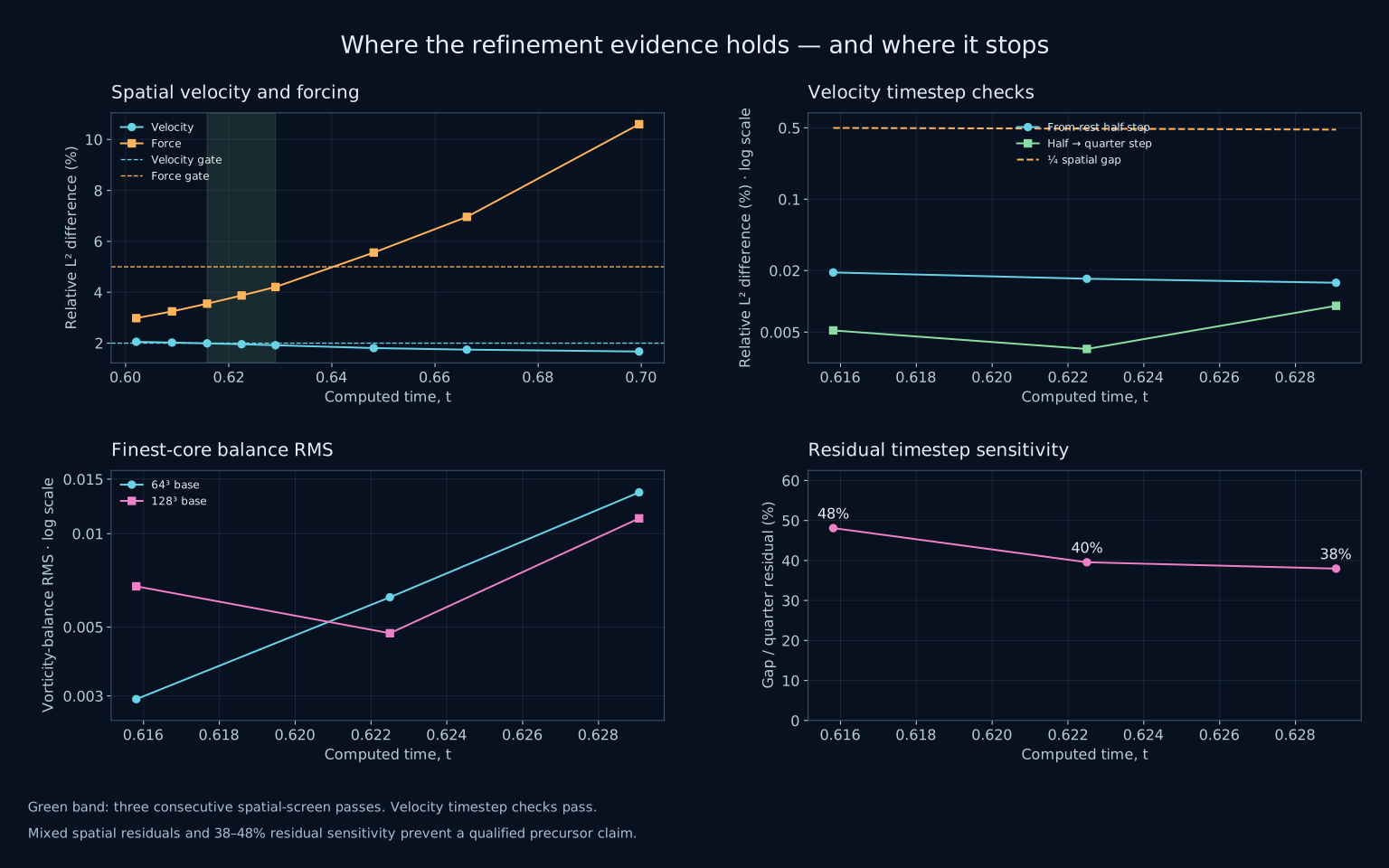
Scroll sideways to inspect all four refinement panels.
Final finite continuation
The accepted 128³-base, five-level branch continues the audited from-rest trajectory through t = 0.9975. Its short shared-checkpoint timestep probe passed before extension: relative composite L² 0.000108707 against a 0.001 limit, and L∞ divided by baseline peak 0.000422193 against a 0.01 limit. The machine record binds the runner, solver, force profile, complete native-frame lineage, endpoint snapshot, analyzer, and figure.
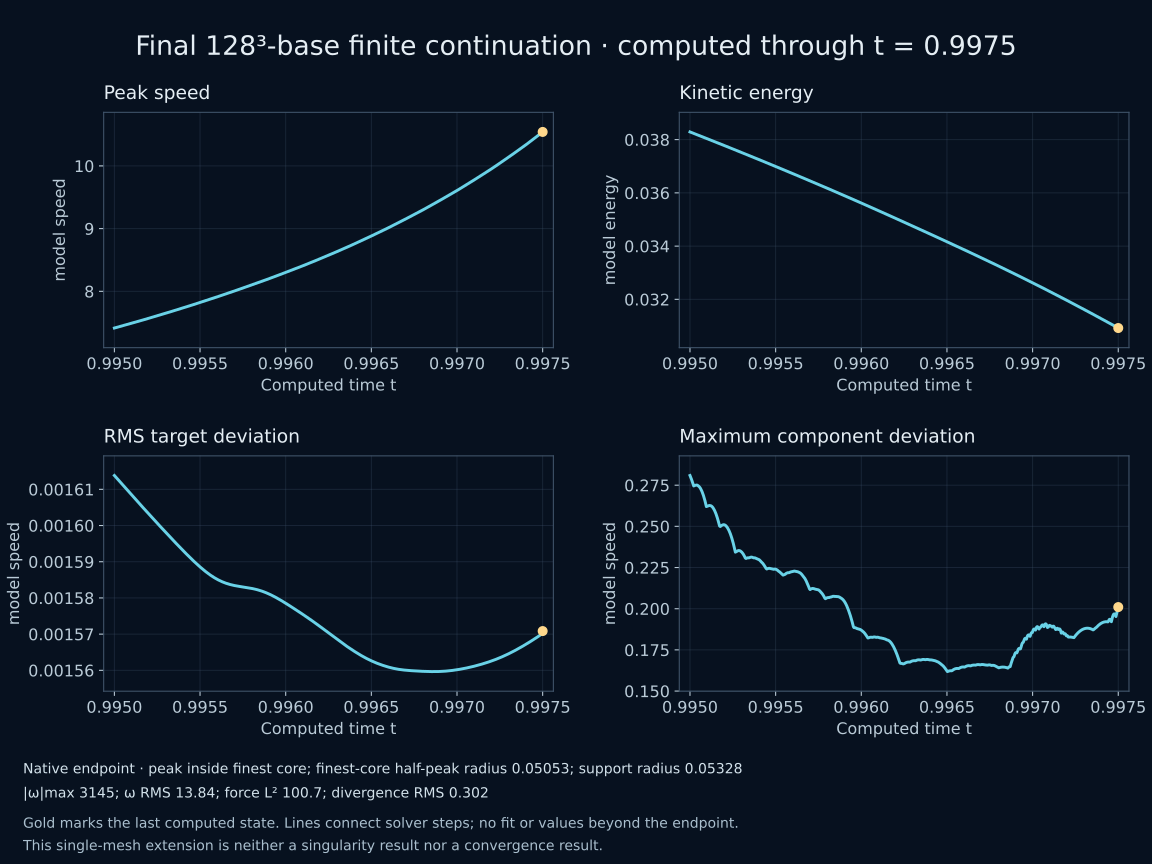
Scroll sideways to inspect all four continuation panels.
| Final computed state | Value |
|---|---|
| Base grid / fixed levels / finest equivalent | 128³ / 5 / 2048³ |
| Endpoint step / time | 6300 / 0.9975 |
| Peak speed | 10.5415658 |
| Kinetic energy | 0.0309232733 |
| RMS / maximum target deviation | 0.00157084116 / 0.200991072 |
| Half-peak support equivalent radius | 0.0532769531 |
| Finest-core half-peak equivalent radius | 0.0505347204 |
| Peak / RMS vorticity | 3144.97245 / 13.8394391 |
| Manufactured-force L² norm | 100.733761 |
| Sampled divergence RMS / maximum | 0.302018277 / 153.534609 |
This extension follows one grid-dependent trajectory beyond the spatially tested interval. It is a finite model extrapolation and does not add a spatial-convergence certificate. The separate refinement evidence identifies 0.615808–0.629071 as a provisional spatial candidate and supports local velocity timestep stability there; mixed residual behavior, material residual timestep sensitivity, and peaks outside the finest core still prevent a resolution-qualified precursor or likely-singularity claim. The analytical paper supplies the blowup result; this computation supplies finite pre-singular diagnostics only.
Reading the movies
The horizontal x–y slice stays at z = 0 and the vertical x–z slice stays at y = 0. Each plane samples the finest containing native cell at 256² display points without spatial smoothing. The isometric panel uses trilinear reconstruction of native magnitudes for visualization, retaining native center spacing in the core.
All 320 saved states appear in order. Ordinary states hold for 0.2 seconds, the initial rest state for one second, and the endpoint for half a second. GIFs and MP4s use the same holds for a total of 65.1 seconds. Saved simulation times become closer together toward the endpoint, so the playback clock is not proportional to simulation time.